
The multi‑layer hybrid‑cloud reference architecture for enterprise AI — including the AI control plane, agentic AI layer, MCP integration, data and feature layers, and model/inference strategy.
This page provides the complete enterprise AI reference architecture used across DEAA’s consulting, advisory, and transformation engagements. It defines the structural layers required to deploy secure, governed, scalable AI systems across hybrid‑cloud environments.
The architecture integrates:
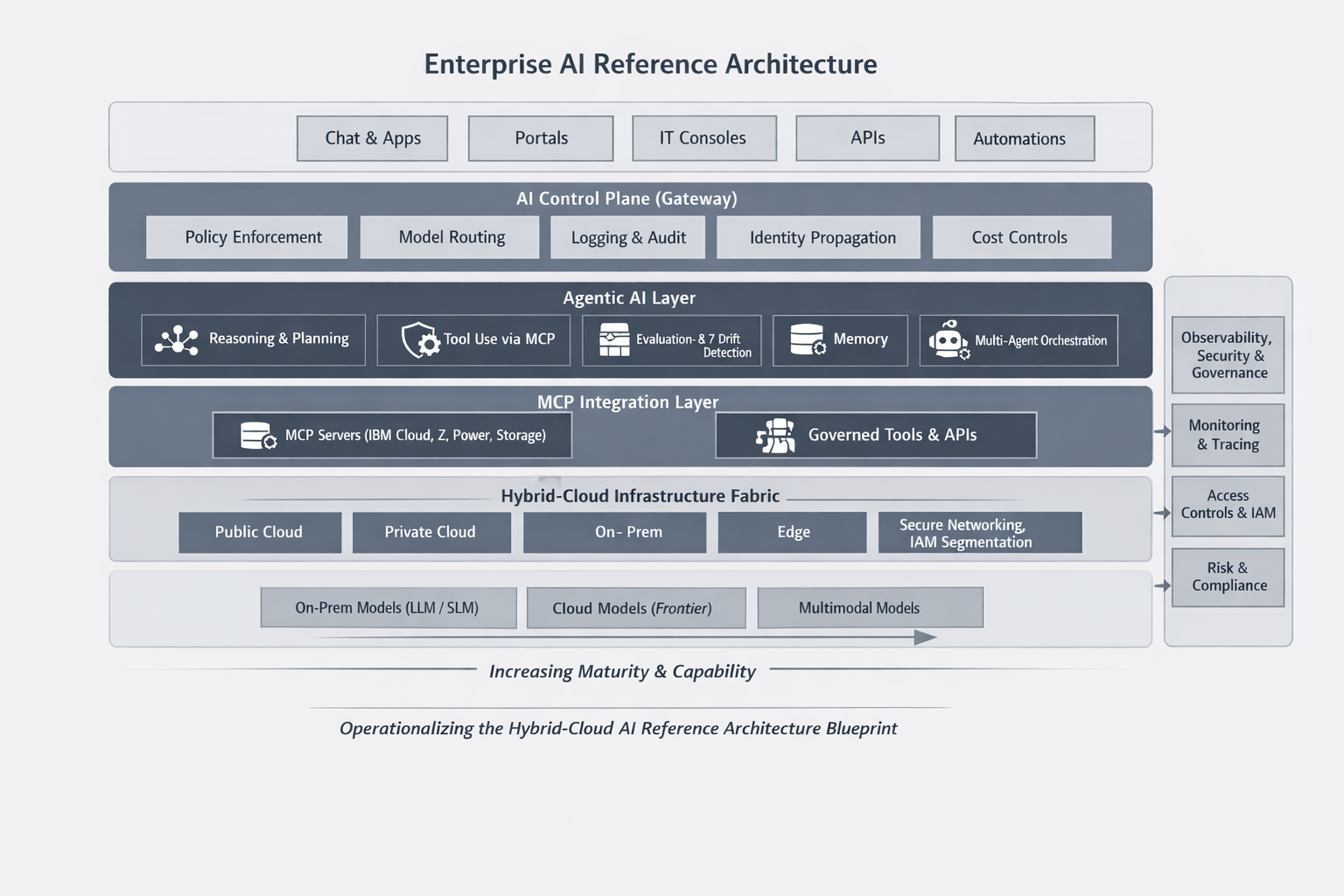
The definitive multi‑layer architecture for enterprise AI systems. This blueprint provides a complete structural model spanning infrastructure, control planes, data layers, models, agents, and governance.
The blueprint includes:
The foundational layer providing secure connectivity, identity federation, segmentation, and compute across public cloud, private cloud, on‑prem, and edge environments.
The central nervous system of enterprise AI, responsible for policy enforcement, model routing, identity propagation, guardrails, logging, and cost governance.
Unified lakehouse, vector indexes, feature stores, and real‑time pipelines with embedded governance, lineage, and quality controls.
Hybrid model strategy combining cloud frontier models, on‑prem models, and multimodal models with routing, caching, distillation, and cost optimization.
Implements the Agent Development Lifecycle (ADLC) with memory, planning, tool use via MCP, multi‑agent orchestration, and self‑evaluation.
Cross‑cutting layer providing reasoning traces, tool call logs, drift detection, sandboxing, isolation, NIST AI RMF alignment, audit trails, and kill switches.
The following diagram illustrates the full multi‑layer architecture, showing how user interfaces, the AI control plane, agentic AI capabilities, MCP integration, hybrid‑cloud infrastructure, data layers, and model/inference components interconnect.
Use this page as the authoritative reference for designing enterprise‑grade AI systems. It provides the structural blueprint that informs capability models, solution architectures, platform design, and implementation planning across hybrid‑cloud environments.